The E-T Nexus: Connecting Evaluation and Transformation
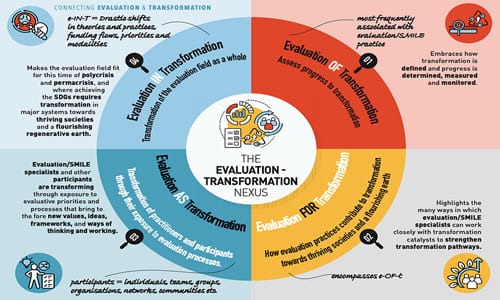
In this age of intensifying complex and interwoven crises, evaluation professionals increasingly and inevitably have to work in spaces where evaluation and transformation meet - that is, work at the 'evaluation-transformation (E-T) nexus'
Evaluation professionals are a diverse crowd. We enter the field from many diverse backgrounds. We are not grounded in educational standards requirements in the same way as other professions. As a result, we often talk past one another.
This is very apparent when we deal with transformation. Transformative evaluation. Transformational evaluation. Evaluation supporting transformation. Transformation-focused evaluation. Transformation-inspired evaluation. Are they the same? How different? How can we be clear and precise when we define, explain and do what we do when we engage with transformation? Will such clarity help prevent the increasingly prevalent 'transformation-washing' in our field?
In 2021 the David and Lucille Packard Foundation allocated a small grant to a small group of us who shared the same keen interest: How can we unravel the implications of the growing importance of transformation for the evaluation field, and inspire focus and impactful work where these two fields connect? Over the next nearly four years the 'Transforming Evaluations Collective' - Louise Gallagher, John Colvin, Aaron Zazueta, Taruna Gupta and I - wove this notion into our work, intermittently joining forces to explore key issues together.
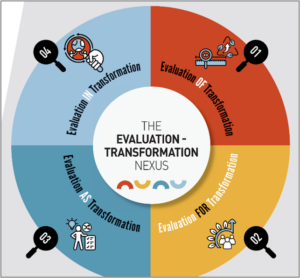
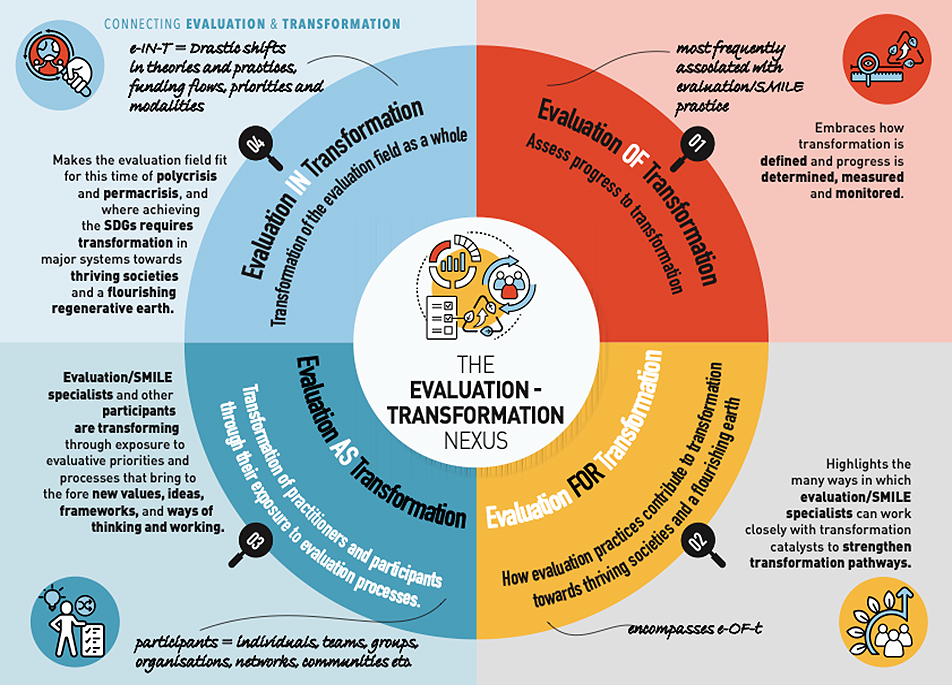
One of our first contributions for the Foundation was to identify four interconnected lenses through which all work done at the E-T nexus could be viewed and described. They overlap, but give clarity that has been lacking.
They became the framework around which we structured all our work for the Foundation:
- Evaluation OF Transformation (e-OF-t)
- Evaluation FOR Transformation (e-FOR-t)
- Evaluation AS Transformation (e-AS-t)
- Evaluation IN Transformation (e-IN-t).
Lens 1. Evaluation OF Transformation (e-OF-t)
Evaluation OF transformation is what most of us think about when we work with transformation in evaluation practice.
It refers to evaluative thinking and practices that quantitatively and qualitatively measure, analyse and assess progress and contributions towards the transformation of one or more systems in which we are interested.
It means tracking over time the accumulated progressive shifts in the system(s) in the desired direction, and in the conditions and patterns that have kept the current/old system in place. We already have many approaches and methodologies from which we can select, and while those most appropriate continue to evolve, the resources and time to apply them and to innovate further are less abundant.
We can do such tracking for unintended transformations, like those resulting from the COVID-19 pandemic, climate change, major wars and earthquakes.
We can also do it for intentional transformations, such as ongoing deliberate efforts to transform energy, agrifood, financial or economic systems to better serve society and nature.
A well-known documented example of this type of work is the rubrics that are used to assess weak or strong signals of progress, based on the five TCLP dimensions of transformational change. Other examples have been developed or are under development by Oak, Laudes and Mastercard Foundations, among others.
Lens 2. Evaluation FOR Transformation (e-FOR-t)
Evaluation FOR transformation encompasses, but also goes beyond e-OF-t. It focuses on the many ways in which evaluation specialists can work closely with transformation catalysts to strengthen transformation pathways towards thriving societies and a flourishing Earth - leveraging and advancing evaluation's value at every step.
Transformation catalysts are individuals, groups or organisations who drive deep, systemic change by connecting stakeholders, shifting mindsets, and fostering collaboration towards just and sustainable futures. They challenge entrenched systems, disrupt harmful patterns, and create conditions for transformation. In today's world their role is vital, requiring innovative, networked and holistic approaches.
Evaluation professionals do not just support catalysts; we can also become them. Our expertise in what works (or not), why, how, and under what conditions gives us many entry points: guiding direction, design, implementation, adaptation, or scaling. We have a strong tradition of working with theories of change, monitoring, and embedding evaluation into learning. We apply transformation-focused evaluation principles, and practices such as diagnostic, design, developmental, and real-time evaluation. We use methodologies such as process tracing, contribution analysis, and outcome harvesting, as well as approaches from other areas of work, such as horizon scanning and foresight.
The evolution of our field from 'Evaluation' to MEL to MERL to SMILE (strategy, monitoring, impact, learning and evaluation) shows us its increasing value for such support.
Lens 3. Evaluation AS Transformation (e-AS-t)
Evaluation AS transformation focuses on the impact of evaluative practices and processes that in themselves are powerful enough to bring about transformative change among and within evaluation/MEL/SMILE specialists, and those with whom they work. They are deeply touched, and even transformed through the evaluative frameworks and processes that the evaluation practitioners use - new values they may bring to the fore, new frameworks and concepts, or principles and processes that change mindsets, power relations and practices, promote and inspire transformative change among individuals, teams and groups.
Here, the transformative effect is not necessarily in a system - although it may eventually lead to changes in systems. It draws attention to efforts outside the evaluation field to work towards inner transformation, among others through the inner development goals.
Some of the most powerful approaches that can facilitate this type of transformation - and could eventually lead to changes in systems - are Indigenous Evaluation, Donna Mertens' Transformative Evaluation, Footprint Evaluation and other values and principles-based evaluation approaches.
Lens 4. Evaluation IN Transformation (e-IN-t)
Evaluation IN Transformation focuses on how the field of evaluation itself must evolve to better support transformation-focused approaches. As pioneering individuals, teams, organisations, communities of practice, and coalitions push boundaries, they drive broader shifts in both theory and practice-helping reshape evaluation to meet the challenges of our time.
Our work for the Packard Foundation has highlighted just how quickly evaluation is expanding into a multifaceted field, deeply connected to social justice, sustainability, equity and empowerment. The focus is shifting from simply 'doing no harm' to actively 'doing good,' guided by clear values; embracing more dynamic, responsive practices that support continuous learning and adaptation; and positioning evaluators as facilitators or participants within teams, rather than as external observers.
But despite these shifts in purpose, practice, and institutional structures, change isn't happening at the scale needed to transform the field as a whole. To effectively tackle today's 'wicked problems'-complex, interconnected challenges that demand holistic and adaptive approaches-the evaluation field as a whole must move beyond isolated innovations toward their more unified, intentional application. This process is still ongoing, and has to be accelerated.
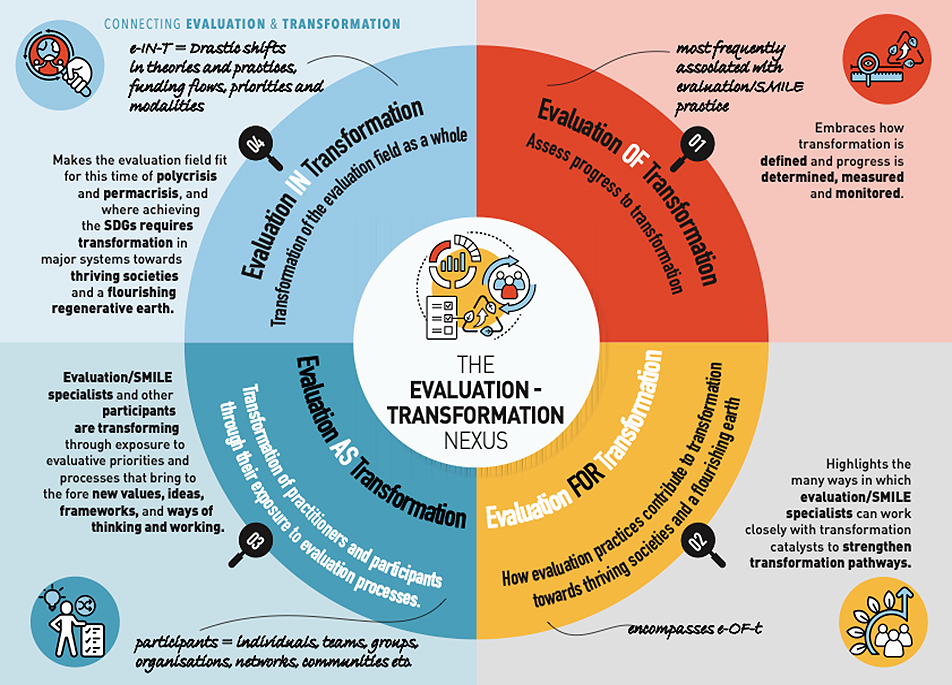
Click here to see a larger view of the above image.
Together, these lenses make up an interconnecting story.
Evaluation OF transformation (e-OF-t) highlights our ability to assess progress and contributions in a certain desired direction.
Evaluation FOR transformation (e-FOR-t) shows how much additional value we can add to efforts to inspire drastic change in a complex and uncertain world, using evaluative thinking and practice.
Evaluation AS transformation (e-AS-t) shows how what we do, and how, can transform ourselves and those with whom we work, as we work to transform systems.
Evaluation IN transformation (e-IN-t) reminds us that there is still much to do to ensure that our field can respond effectively to the crises and opportunities confronting humanity today.
This framework can help those of us working in evaluation and/or in transformation in several ways.
It can help us to understand more precisely for which lens we need more effort.
It can help us to gain competence in one lens and then focus on the next.
It can give us a more nuanced choice of entry points into the world of transformation and evaluation, and to match entry points to our preferred mode of work, for example as activist or as facilitator.
And where e-FOR-t was originally where as a Collective we placed everything in the transformation-focused evaluation space, it is now a specific lens with a focus on collaborations between evaluation professionals and transformation catalysts.
It will be a good step forward if we can all use one or more of these lenses to explore and describe more precisely where our interests lie, and where our contributions are being made.




Member discussion