Guest Post: Principles for Transforming Economics
This is a very important guest post by three eminent transformation specialists whom I greatly appreciate as people and as professionals - Sandra Waddock (Boston College Carroll School of Management), Steve Waddell (Bounce Beyond, Boston) and Jasper Kenter (Aberystwyth Business School, Aberystwyth University, Wales, UK). The post is important, first because it demonstrates the type of thinking and work that can inspire the large-scale transformations we need today; second, because it addresses the global economic system that more or less determines how we all live; and third, because it provides us with a great opportunity to collaborate across our disciplinary boundaries at the evaluation-transformation nexus. We need to bring the full value of evaluation to bear in support of efforts such as these - and there is much scope to do so given all the approaches and techniques we have in hand. Enjoy this short read, and take the time to engage with the longer article in Nature Sustainability too.
Conventional economic thinking is failing humanity badly. Sometimes called neoliberalism, this economics advocates for global markets being able to solve social and ecological issues: they do not. It advocates less government regulation as a way to benefit businesses: but that hurts people - and the rest of nature - everywhere. Although resistance to globalisation and neoliberal thinking has been rising, there is desperate need for new ways of economic thinking.
To determine realistic alternatives, our global team systematically assessed 38 alternative economic approaches focused on human and planetary wellbeing to identify their common principles. We found ten principles for transforming economics that incorporate social, ecological and political economy considerations. These approaches include schools of economics, like post-Keynesian and feminist economics, economic perspectives like doughnut economics, fair markets and post-development, and broader Indigenous perspectives like buen vivir and ubuntu.
In developing this study, we recognised that the world is experiencing massive social and ecological problems indicating a need for transformational system change. These issues are increasingly labled 'polycrisis', or the intersecting set of life- and civilization-threatening emergencies. Polycrisis includes climate change, transgressing planetary boundaries, biodiversity loss, inequality and erosion of democratic norms, among others. Taken together, such crises signify an increasingly recognised need to shift away from today's take-make-waste economic practices towards ones that incorporate social and ecological considerations.
The ten principles for transforming economics fall into four main categories: holistic, ecological, social, and political economic.
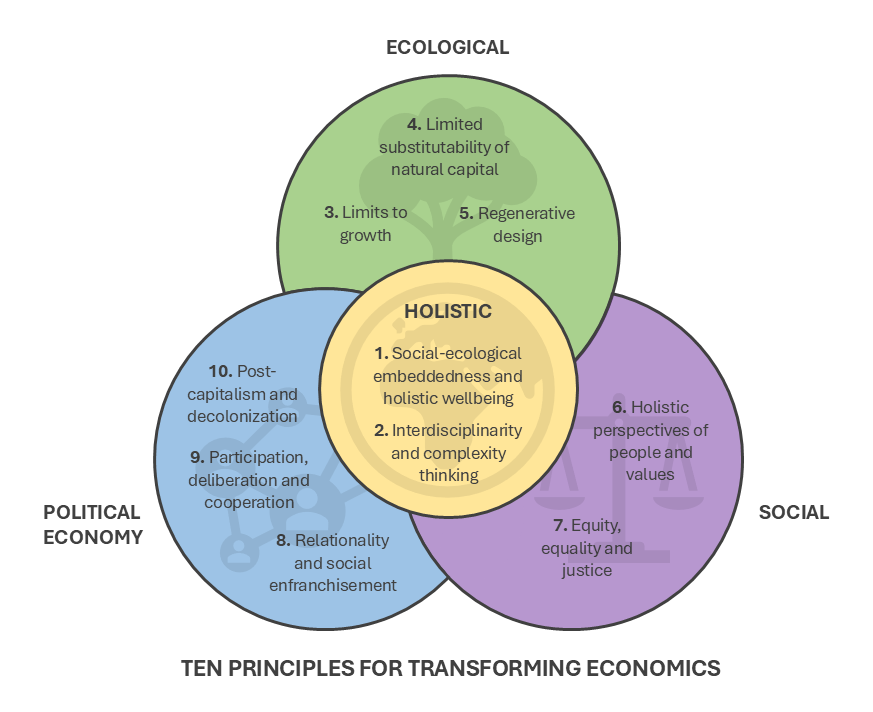
Two holistic principles include: social-ecological embeddedness and holistic wellbeing; and interdisciplinarity and complexity thinking.
Social-ecological embeddedness recognises that economies are nested within societies and societies within ecosystems, and that the basic purpose of economics is to support sustainable human and planetary wellbeing.
The second holistic principle, interdisciplinarity and complexity thinking, explicitly acknowledges that the real world is inherently complex and economic problems need to be understood from the intersection of multiple disciplines.
Three ecological principles include: limits to growth; limited substitutability of natural capital; and regenerative design.
Limits to growth acknowledges the reality that there fundamental biophysical and biochemical limits to growth. Unlike the premise of neoliberalism, economic growth cannot continue indefinitely when there are planetary limits to growth.
Limited substitutability of natural capital recognises that all the raw materials and resources used to produce what humans need to survive come from nature. There is no substitute for nature, and by implication, humans themselves are part of not separate from the rest of nature.
Regenerative design means that economic and other human systems need to incorporate principles of circularity and regenerativity to support human and nature's wellbeing into the future.
Two social principles include: holistic perspectives of people and values; and equity, equality and justice.
Holistic perspectives of people and values argues for pluralistic understandings of values and human behaviour, rather than the conventional economic model of people as selfish maximisers with no real interest in others or the common good. Freedom is not primarily considered as freedom from regulation, but more broadly as the freedom to achieve the life that people value.
Equity, equality and justice means that these values need to become the central questions of economics, not peripheral to or, as they are in neoliberalism, ignored aspects of economics.
The three political economy principles are: relationality and social enfranchisement; participation, deliberation, and cooperation; and post capitalism and decolonisation.
The idea of relationality and social enfranchisement argues for an integration of relational worldviews and values, of care, community, love and reciprocity into economic thinking and policy. This principle is reflected in securing universal access to basic services, and holistic, integrated evaluation and reporting, including metrics that recognise the profound value of unpaid care work.
Participation, deliberation and cooperation means supporting everyone's need for belonging and voice, along with the ability to actively engage with and participate in decisions that affect the companies, communities and societies to which people belong.
Post-capitalism and decolonisation recognises that many people, not to mention aspects of nature, have been marginalised as a consequence of colonisation in the past. Taking post-colonialist perspectives means ensuring that any negative consequences of such practices do not persist into the future. Rather than a single blueprint, post-capitalism advocates diverse approaches, applications, and perspectives on markets, monetary and financial systems, such as new forms of cooperative enterprises and decentralised ownership enabled by digital technologies.
These principles provide a foundational basis for designing new economics thinking, strategies and organisations at scale. They allow for assessing whether innovations move in the visionary direction of enabling humanity to living within the bounds of planetary resources. Our team believes that these ten principles, incorporated into economics, can help mainstream new economic thinking that will benefit all people - and the planet. It is past time to move beyond the self-interested, shareholder wealth maximising, governmentally destructive practices of take-make-waste neoliberal economics towards more regenerative and hopeful economics that supports the future of all humans and the rest of life.
***
This study, Ten Principles for Transforming Economics in a Time of Global Crisis, was produced by a collaboration of Jasper Kenter (Aberystwyth University, Wales, UK), Simone Martino (James Hutton Institute, Aberdeen, UK), Sam Buckton (York University, UK), Sandra Waddock (Boston College, USA), Bina Agarwal (Institute of Economic Growth, Delhi, India), Annela Anger-Kraavi (University of Cambridge, UK), Robert Costanza (University College, London, UK), Adam Hejnowicz (University of York, UK), Peter Jones (Tecnológico de Monterrey, Mexico City, Mexico), Jordan O. Lafayette (Ecologos Research Ltd, Aberystwyth, Wales, UK), Jane Kabubo-Mariara (Partnership for Economic Policy, Nairobi, Kenya), Nibedita Mukherjee (Brunel University, London, UK), Kate Pickett (University of York, UK), Chris Riedy (University of Technology, Sydney, Australia), and Steve Waddell (Bounce Beyond, USA).




Member discussion