Arendalsuka: Democracy in 2,000 sessions, 180 venues, 5 days, 190,000 participants ...
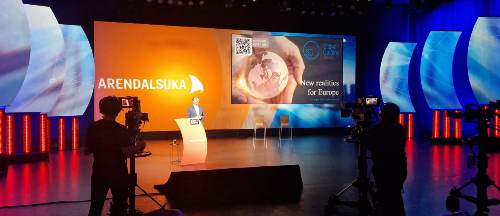
Imagine a beautiful Norwegian coastal town where, over five days, more than 2,000 discussions, debates and cultural sessions cram 180 venues - beyond formal halls, in cafés, wharfs, stalls, tents, and even boats!
Government ministers, leaders and representatives of agencies, political parties and social movements, CEOs, academics, activists, NGOs and ordinary citizens - all interacting on equal footing, and free of charge.
No VIP entourages. No noticeable security.
A crowd of citizens, said to be more than 190,000 (corrected on 27 Aug 2025).
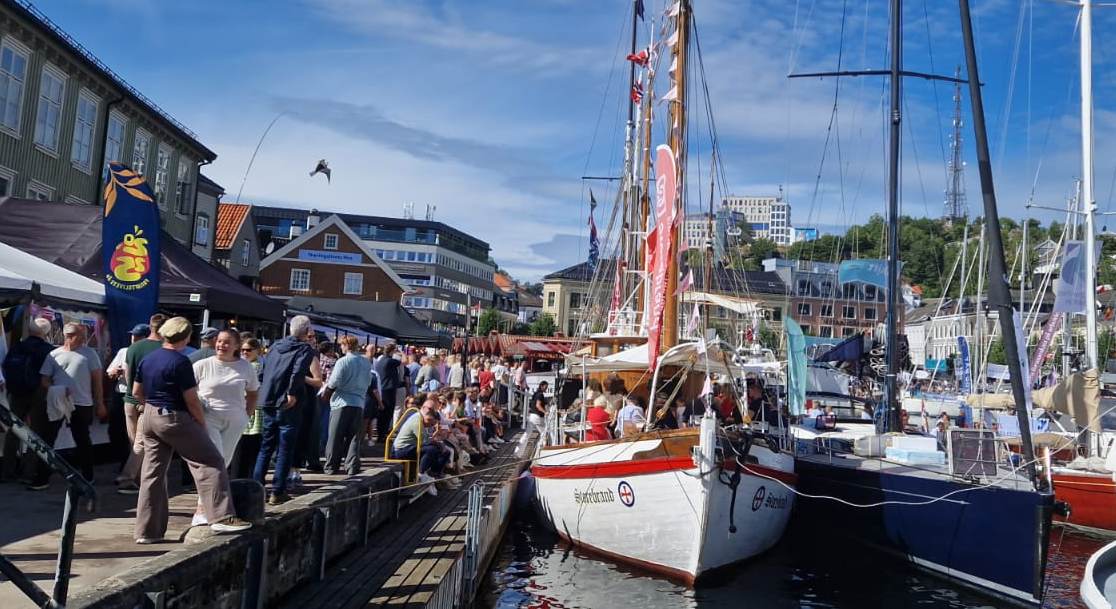
Thanks to Henrik Nordal and Kai Brand-Jacobsen of the Independent Evaluation Department of Norwegian Development Cooperation, I had the privilege and real pleasure last week to be part of Arendalsuka 2025, Norway's 5-day 'democracy festival' held since 2012 in the beautiful coastal town of Arendal.
The week-long event integrates civil society, government and private industry in one compact, walkable setting, fostering spontaneous cross-sector dialogue.
Political leaders mingle with the public on the street.
Corporate representatives share stages with climate activists.
Cabinet ministers walk between venues unescorted, engage in informal conversations, and debate alongside university students.
International delegations share topics such as European security, energy cooperation and democratic resilience with ordinary citizens.
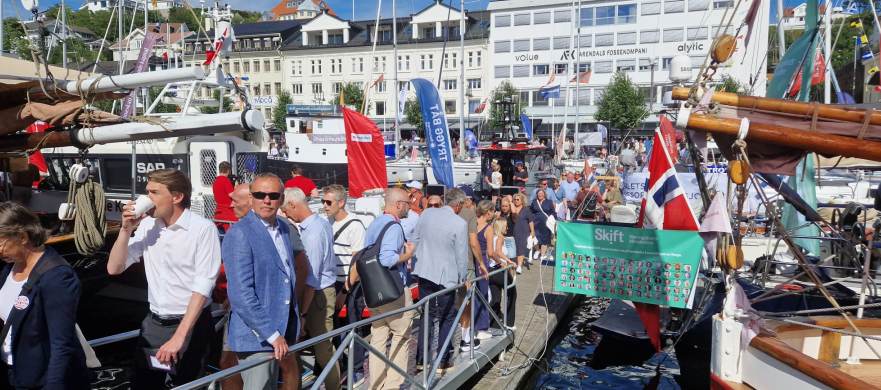
Arendalsuka is unusually open access - completely free and open to all citizens. Anyone can register and host an event without official vetting. Topics are broad, from national politics and climate policy to technology innovation and social issues.
It blends politics with arts, concerts and local community life, making engagement appealing beyond policy wonks. It also blends high-level political dialogue with informal, street-level accessibility, demonstrating a uniquely Scandinavian model for lowering barriers to democratic engagement.
Lots of earnest questions are asked. But also lots of talking, eating and mingling, including in sessions and parties on the many boats lined up against the wharfs. Laughter until late in the evening!
A counter-model to elite political discourse
Arendalsuka is one of several 'democracy festivals' in Scandinavia and increasingly also in other parts of the world, established as counter-model to elite political discourse. Some say it is unintentionally still too much a conversation between the educated elites, with insufficient time in sessions for deep engagement. But Arendalsuka provides a remarkable case study in participatory political culture and civic dialogue.
At the very least it raises awareness of diverse perspectives on critical issues, and of emerging initiatives that will impact society. I am also told it has become something of a barometer of Norway's political climate, especially during an election year.
I am with good reason a cynic about democracy in practice - the emphasis on often-manipulated elections, the way it is currently being perverted in the Western world, and the misuse of the concept for soft power and propaganda purposes. This experience helped restore some of my belief that it can be made to work well where there is serious intent to do so (Switzerland, where I am currently based, being one).
Just compare this 'democracy in the streets' with for example Davos with its top-down, elite-driven agenda-setting, or the Munich Security Conference with its 500 invitation-only participants - two of many events where performative politics and closed-door sessions prioritise private deal-making over transparent dialogue on issues of concern to citizens.
An event like Arendalsuka challenges the notion that meaningful political discourse requires either elite gatekeeping or populist spectacle. It sets a good example for democracies worldwide struggling with political polarisation and declining civic engagement.
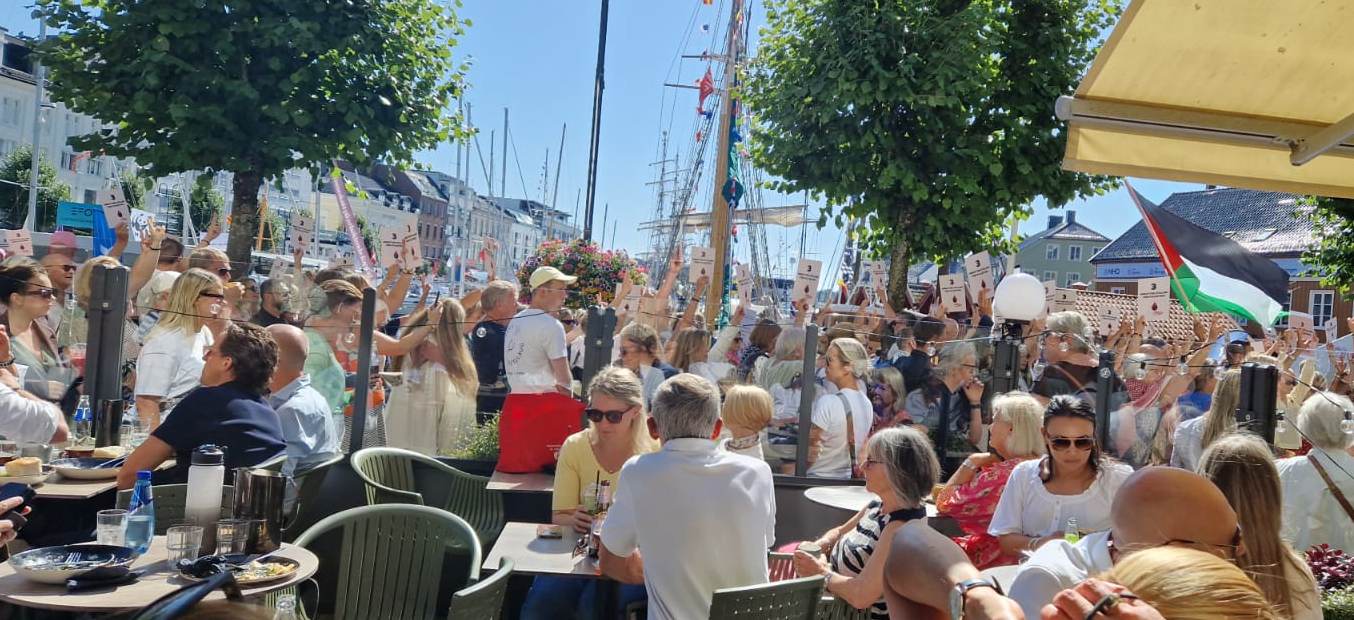
And it had a very effective "3 minute silence for Palestine" protest amid the crowds, with everyone - including where we were in a cafe nearby - falling silent.
Our session: Improving international development through evaluation
Our session focused on the critical issue of how evaluation and innovation can "strengthen the relevance, effectiveness and accountability of Norwegian development cooperation in this time of growing global challenge". It was a pleasure to share the free-flowing conversation with Cedric de Coning, Claudio Alberti and Eirik Mofoss, with Kai Brand-Jacobsen as moderator.
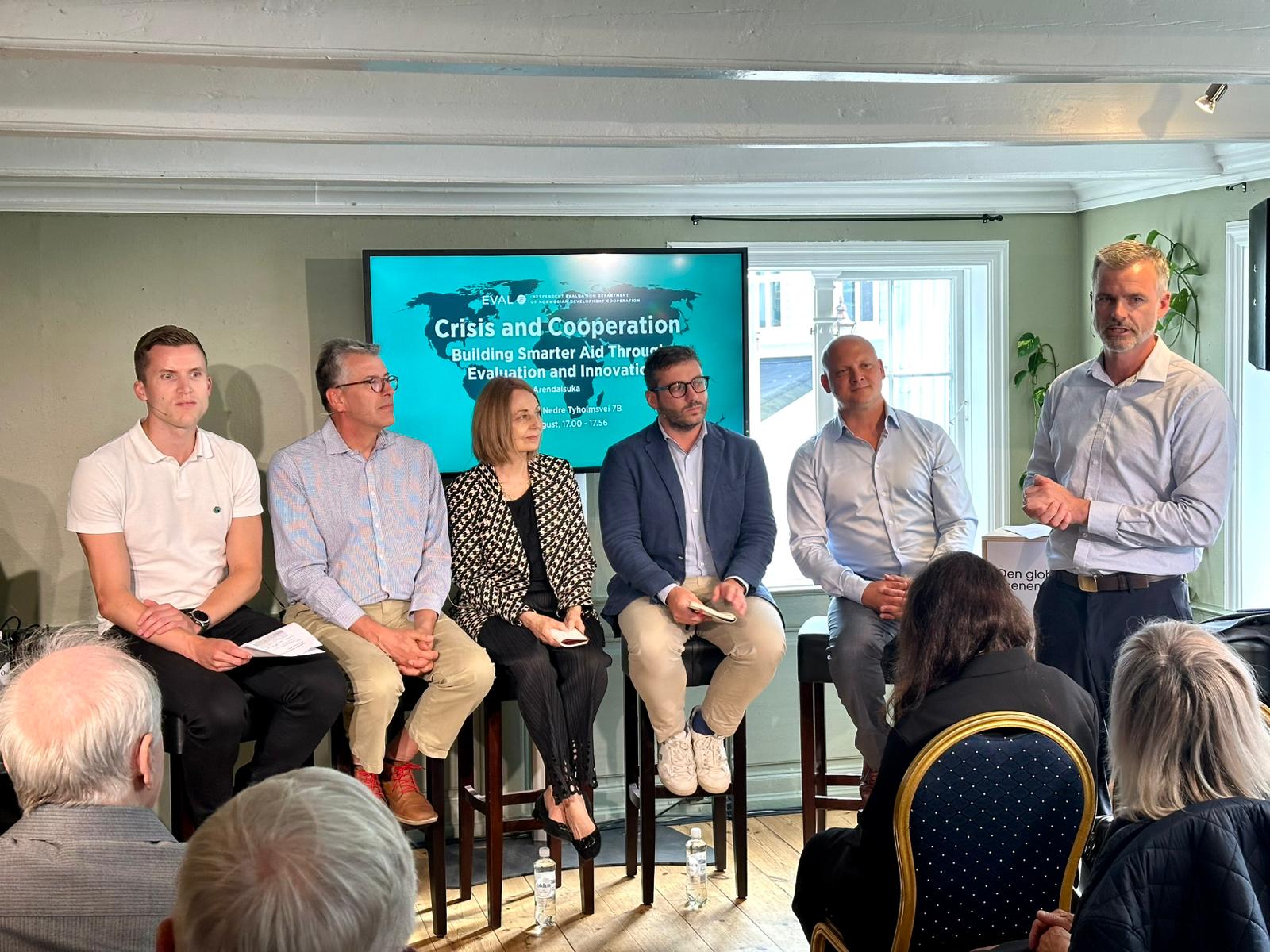
We raised many important issues to consider. But what stuck with me was what I would have liked to say when we were asked for a last piece of advice about what should be done in practice to improve development cooperation through evaluation. Our responses needed more than we could give in the brief moments at our disposal. So here, the foremost thoughts that crossed my mind; there is so much more to be said:
- Help us to change course as a field - away from results-based management, and impact- and transformation-washing, and towards evaluation as a navigation system that can be of real value in this era of volatility and uncertainty. Idealistic, yes, given political and funding imperatives, but we need more experimentation and demonstration in practice that can help us to put RBM to bed.
- Shift evaluation to a stronger focus on design and implementation phases, using frameworks and practices that we know are appropriate for a time of transformation. We need to lose our obsession with 'measuring impact' and instead help policy, strategy and portfolio designers sense whether they are creating the conditions for desired change to emerge, and are making progress towards it. We know how to do it, yet have little opportunity to apply this in practice.
- Focus on synthesis, and learning from those who experienced transformative development. AI makes synthesis much easier - although we need to be very sensitive to its superficiality. And now we have examples of very significant development success from around the world; we can look at it through new lenses to understand what really works, why, how, where, for whom, with what capabilities, and under what circumstances.
- Help us to get serious about contextualisation and localisation, about real partnerships, drawing from what we already know about what works and what does not, and why, in such efforts. It is not a simple matter.
- Renew our thinking about evaluation criteria and questions, and what 'success' really means, so that we can get to the essence of what needs to be known by whom and when to have a greater chance of success - while seriously engaging with different perspectives and cultures that often give very different meanings to credible evidence, to judgment, to causality, to progress, to impact.
- Connect futures thinking and evaluation. No analysis, findings, conclusions or recommendations can afford to reflect a static world.
And finally ...
Much appreciation to the new Independent Evaluation Department team of Norwegian Development Cooperation. Such diversity of cultures, perspectives and skill!
And a very special thank you to Kai for your hospitality and care, for securing for us the quiet cottage with its great view, for a lovely seafood dinner on the water hosted by Henrik and yourself, and for an even more inspiring sunset-to-late-evening Rana boat ride along that beautiful coastline.
May your work as Department flourish as you continue to strive to contribute to a better world.

Member discussion