Titbits and Snippets 2. Words have Weight
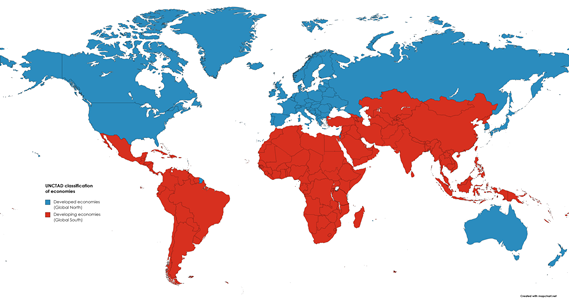
Why do we still tolerate the terminology of "Developed" and "Developing" countries?
Words have weight. They create images and dominant narratives that often insidiously infect our minds and what we believe.
Think of the difference in feeling when you hear "Governments" and "Regimes" - the latter always used for governments that Western powers do not like.
Or "Democratic" and "Authoritarian", as if there are no shades in between, and one is always better than the other.
Take "Freedom fighters" and "Terrorists". Today Nelson Mandela would very likely have been the victim of a drone assassination; after all, he was taken off the US terrorism list only in 2008, 14 years after saving my country from civil war and overseeing South Africa's transition to democracy!
"Military force" and "Militias".
"Billionaires" (US) and "Oligarchs" (Russia).
The notion of "Developed and "Developing" countries, and the so-called "Advanced Economies" and "Emerging Market and Developing Economies" replaced the odious "First" and "Third World", and even worse, "Advanced" and "Backward" countries of earlier times.
But this terminology continues to project a sense of superiority based on the underlying assumption that (mostly) Western industrialised nations represent the pinnacle of progress that all other countries should aspire to reach.
It positions Western nations as the standard of success and progress, while implying that other countries are incomplete, immature, lacking.
It justifies continued Western dominance in international discussions and global institutions, as if "developed" countries are positioned as natural leaders who should guide global economic policy.
It legitimises conditional aid programmes that require "developing" countries to adopt Western economic models and governance structures.
It contributes to persistent global inequalities by creating self-fulfilling prophecies. Countries labelled as "developing" often face higher borrowing costs, reduced investment and condescending policy prescriptions that may not fit their contexts or needs.
It obscures the reality that countries may excel in different area; for example, a nation may have advanced healthcare (e.g. Cuba) or education (e.g. Vietnam) systems yet have a lower GDP per capita.
It also fails to recognise that some countries have chosen different development paths that prioritise sustainability, equality or cultural preservation over pure economic growth (e.g. Bhutan).
Yet the aid industry, and even the UN, meekly continue to use these terms.
The legacy of this terminology demonstrates how seemingly neutral technical language can embed and perpetuate power relationships, shaping not only policy but also how entire populations understand their place in the global hierarchy.
It suits many to continue to use it.
The real point is this: No country can call itself "developed" today.
Not when reductionist, short-term thinking and policies, comfortable lifestyles and wealth built on extraction and the domination of others have led to massive global inequalities and injustice, and to the accelerating demise of our planetary home.
Moving beyond these classifications requires not just new terminology, but fundamental shifts in how we conceptualise progress, success and the relationships between nations.
HICs, MICs, LMICs and LICs do not cut it. Countries should not be defined by their Gross National Income per capita except for narrow planning purposes; and even then, their use for the eligibility for development assistance, concessional lending terms and grant programmes perpetuates a similar notion of superiority of one group over the other.
This is why our best option to change this dynamic is to use "Global South" and "Global North" to indicate the still-very-real and important divides in the world.
These terms have meaning that continues to be relevant today. And it is not about geography.
Or the "Global Majority" and "Global Minority" - a reminder that the world as a whole should also consider being democratic if we truly believe majority rule matters.
It is no wonder that even the maps in use reflect efforts to make us - especially Africa - seem smaller than in reality.
Expect efforts by those in power to cast doubt over the legitimacy and usefulness of these less emotive terms.
Member discussion