Narratives

Stories shape what we see and understand, and what we miss. Posts here examine how narratives about progress, development, evidence, success and failure frame thinking and action about transformation, evaluation, systems, and the future, and determine whose reality counts. A Global South lens infuses the posts.
09
Oct
We Have to Rethink Human Rights, Part 2

We Have to Rethink Human Rights, Part 2

Building on Part 1, this post explores what lies beyond a single universal model of human rights. Drawing on diverse cultural traditions and philosophical systems, it makes the case for pluralistic approaches that honour different ways of understanding dignity and justice.
6 min read
10
Jun
Words have Weight

Words have Weight

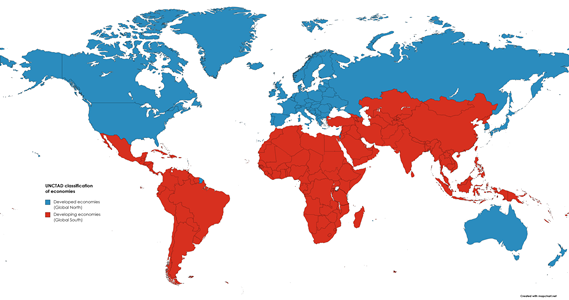
Why do we still tolerate the terminology of ‘Developed’ and ‘Developing’ countries? Words create images and dominant narratives that insidiously shape how we think. A brief reflection on how language reinforces power imbalances in global development.
3 min read
03
Apr
“What went wrong with woke?” The problem of measurement and influence.

“What went wrong with woke?” The problem of measurement and influence.

How twisted narratives and simplistic measures can destroy a major effort to do good. This post examines what the backlash against ESG and ‘woke’ culture reveals about the dangers of poor measurement, ideological capture, and evaluation’s role in defending evidence-based progress
4 min read
10
Sep
"Labour" Day? The undervaluing of lives and labour in the Global South

"Labour" Day? The undervaluing of lives and labour in the Global South

This is an expanded version - especially in terms of key messages for evaluation professionals - of a post that I wrote

5 min read
13
Jun
Guest Post: Narratives, Stories and Memes

Guest Post: Narratives, Stories and Memes

How can we evaluate well if we are not aware of the often 'single stories' that shape how
5 min read
30
Apr
Learning from China’s Transformation, Part 6.   Co-evolution - a ‘first principle’.

Learning from China’s Transformation, Part 6. Co-evolution - a ‘first principle’.

Co-evolution – the mutual shaping of institutions, markets, society and governance over time – emerges as a first principle in understanding China’s transformation. This concluding post draws together the series’ lessons for evaluation and development practice
5 min read
26
Apr
Learning from China's Transformation, Part 5. Directed improvisation

Learning from China's Transformation, Part 5. Directed improvisation

China’s development story is an extraordinary example of complex adaptive systems thinking applied to political-economic transformation. ‘Directed improvisation’ – combining top-down strategic vision with bottom-up experimentation – holds vital lessons for us.
8 min read
22
Apr
Learning from China's Transformation, Part 4.  Dominant narratives, alternative perspectives

Learning from China's Transformation, Part 4. Dominant narratives, alternative perspectives

Democracy, human rights, Africa engagement, the Belt and Road ‘debt trap’ – four dominant narratives about China examined alongside alternative perspectives. Why we must demonstrate nuance and pluralism.
6 min read
18
Apr
Learning from China's Transformation, Part 3. Seeing through others' eyes

Learning from China's Transformation, Part 3. Seeing through others' eyes

Our assumptions about China are shaped by narratives we rarely question. This post challenges us to see through others’ eyes – understanding how worldviews, cultural patterning and historical memory shape radically different perspectives on the same reality.
3 min read
16
Apr
Learning from China's Transformation, Part 2. Towards an ecological civilisation

Learning from China's Transformation, Part 2. Towards an ecological civilisation

China’s ambitious vision for an ‘ecological civilisation’ offers a striking counterpoint to Western development models. This post examines how Confucian philosophy, environmental policy and systems thinking converge in China’s approach to sustainable development.
7 min read