Evaluation's Journey towards the Future, Part 4. It has always been political
<p><img src="https://www.zendaofir.com/content/images/2025/11/picture-part-4-900x600-1-300x194.png" alt width="1096" height="709"></p>
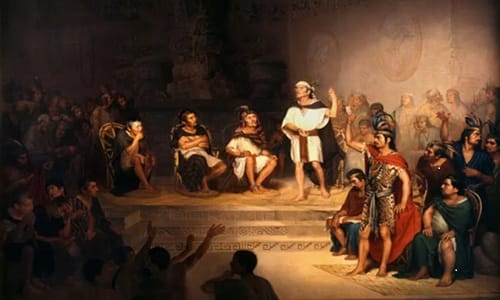
Evaluation has never been neutral. Throughout history, the act of assessing has served as both instrument of control and catalyst for justice. When emperors counted grain stores, when councils assessed their kings, when citizens scrutinised officials, each instance revealed evaluation's inherent political nature.
These traditions also demonstrate evaluation's dual nature. Most historical systems protected elite interests while simultaneously providing social benefits. They could enforce conformity and legitimise rulers, yet also promote accountability and create pathways to advancement based on merit rather than birth.
Examining how diverse societies and governance systems across millennia have used evaluation-long before Western societies "discovered" democracy-may uncover forgotten wisdoms that can help us reclaim evaluation's promise as a force for good.
Evaluation as Instrument of Authority
In ancient societies, evaluation systems often reinforced existing power structures. But in many cases, they also provided essential administrative functions for the common good:
Ancient Egypt's scribes maintained detailed records of crop yields and tax quotas. While restricting administrative power to an elite class and reinforcing divine authority, this system also enabled effective resource management during environmental challenges.
Mughal India's Zabt system replaced feudal tribute with standardised taxation based on land surveys. Though strengthening imperial control, it created more predictable taxation that reduced exploitation by intermediaries.
Imperial China instituted rigorous performance reviews of officials, tying bureaucratic survival to compliance with imperial authority. Yet this system also created one of history's first large-scale accountability mechanisms, combatting corruption and enabling talented individuals from non-aristocratic backgrounds to rise based on merit.
Tokugawa Japan evaluated samurai on martial prowess and loyalty, cementing hierarchical order but also contributing to centuries of domestic peace that allowed arts and commerce to flourish.
The Abbasid Caliphate tested scholars on theological conformity while maintaining tax assessments across its empire. Despite suppressing dissent, these systems funded scientific advancement and maintained infrastructure across culturally diverse regions.
The Roman Republic's Cursus Honorum and censorial evaluations protected aristocratic control while creating predictable advancement paths that promoted civic responsibility.
Medieval Europe's Church used tithe records and inquisitions to consolidate power, yet its evaluative systems also preserved knowledge during political instability.
Colonial Empires deployed inspections and classifications to control populations, claim locals' inferiority, and extract resources. Yet these same systems created documentation that later enabled colonised societies to challenge imperial narratives and repurpose administrative techniques after independence.
Ancient Evaluation aimed at the Common Good
Not all historical evaluation served elite interests. Many societies developed systems aimed at advancing collective welfare:
Ancient Athens practiced dokimasia-scrutiny of officials' character before taking office-and euthyna, financial audits that allowed citizens to challenge corrupt leadership.
Renaissance Florence's Catasto of 1427 transparently funded public goods, spurring debates on wealth and equity.
Indigenous and non-Western societies developed processes akin to participatory evaluation long before colonial contact:
- South Indian temple inscriptions documented resource management for communal oversight;
- The Haudenosaunee (Iroquois) Confederacy in North America held councils where clan mothers and elders assessed councillors' decisions;
- Creek/Muskogean town councils in North America featured open forums where community members could challenge leadership;
- Amazonian Indigenous Communities in South America practiced consensus-based evaluation of initiatives
- The Inca Empire in South America used quipu-knotted cords encoding data-to monitor production and ensure equitable distribution;
- Australian Aboriginal songlines encoded ecological knowledge and dispute-resolution protocols as dynamic evaluation mechanisms guiding sustainable land use and social harmony;
- West Africa's Oyo Empire empowered an elders' council to evaluate royal performance and force abdication if necessary;
- Ashanti truth ceremonies in West Africa weighed grievances through public consensus.
Evaluation's Duality and Implications for the Future
Every evaluative framework carries political weight. The examples show that this has always been so. Many ancient evaluation systems-especially in non-Western governance contexts-represented sophisticated innovations for their time, laying groundwork for more inclusive approaches. While some masked self-interest behind claims of 'objectivity', others harnessed assessment primarily for collective welfare.
Today's technocratic evaluation often mirrors ancient patterns, centralising control while appearing to be neutral. It is clear that evaluation's intent-domination or service-shapes its effects. Yet historical examples also remind us that evaluation can be reclaimed to imagine more just futures. The most beneficial systems in ancient times included public input, moral oversight and feedback loops. Transparency and inclusivity countered patterns of evaluative coercion.
So, trends in this direction today are nothing new.
We need to revive and expand modern versions of ancient participatory evaluation systems to help restore flourishing societies and planetary ecosystems. By designing systems that distribute rather than concentrate power, driven by values and capacities fit for this time, we can harness evaluation's potential as a pathway toward more equitable futures for all beings, present and future.
This has to be done intentionally, based on new forms of power and capacities that can eliminate the power asymmetries that have kept evaluation from achieving its full potential.
It we are to prevent replicating past injustices, we must continue to gain insights for action by questioning the narratives that shape our field. What patterns keep outdated systems in place? Whose interests are being assessed and why? Whose voices and knowledge systems are preferred, and why? Who benefits and who is marginalised, and why?
The issue is therefore not whether evaluation will be political-it always has been-but whether we will use it consciously in service of the common good for people and planet, rather than for control and selfish interests.
Evaluation specialists also have to be much more strategically and politically savvy, irrespective of the space in which they work. We are not technicians who apply methods to get to results. We are working in a field that requires - beyond sophisticated technical expertise - the highest level of strategic and political capabilities if we are to ensure that evaluation is a force for good.




Member discussion